


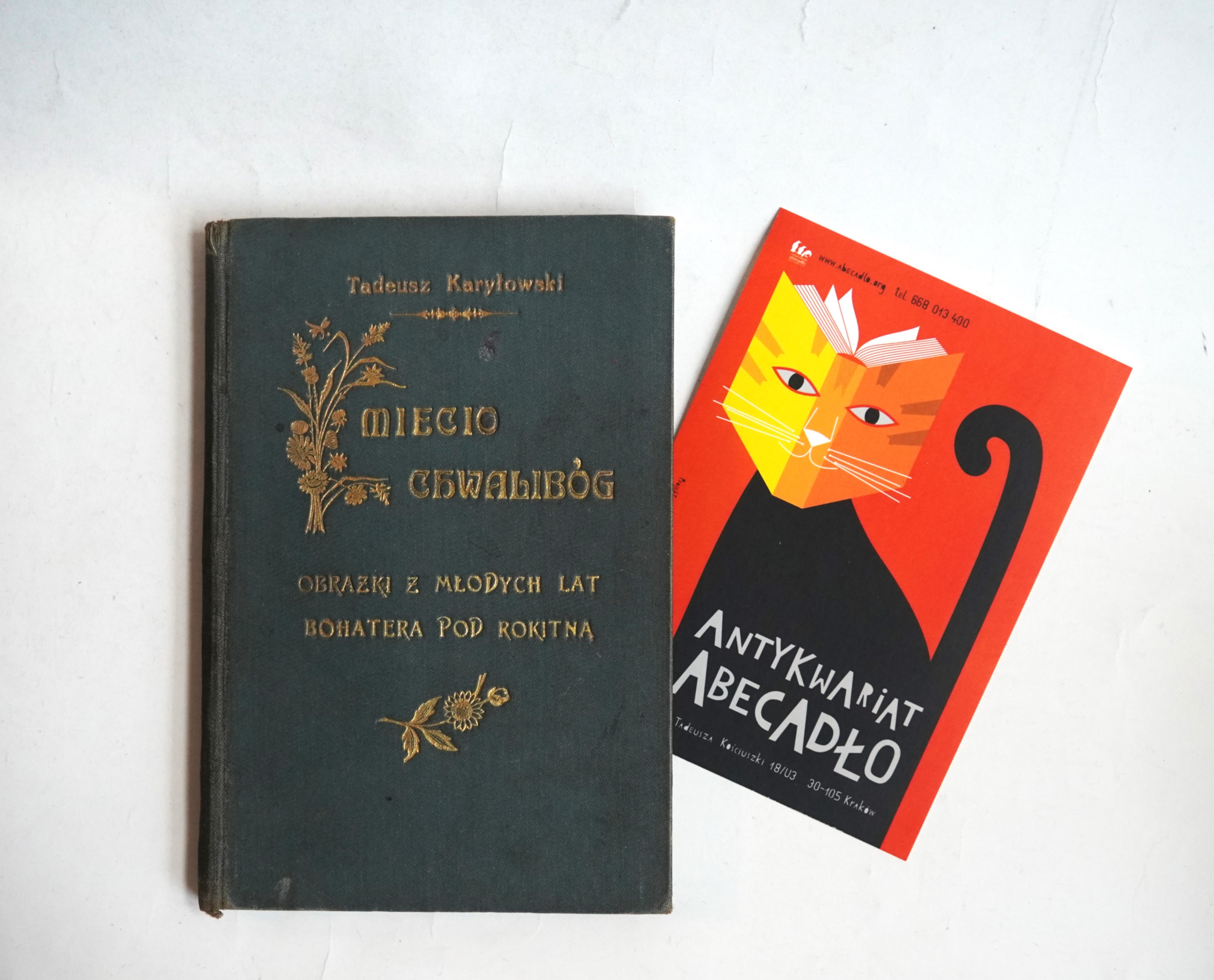
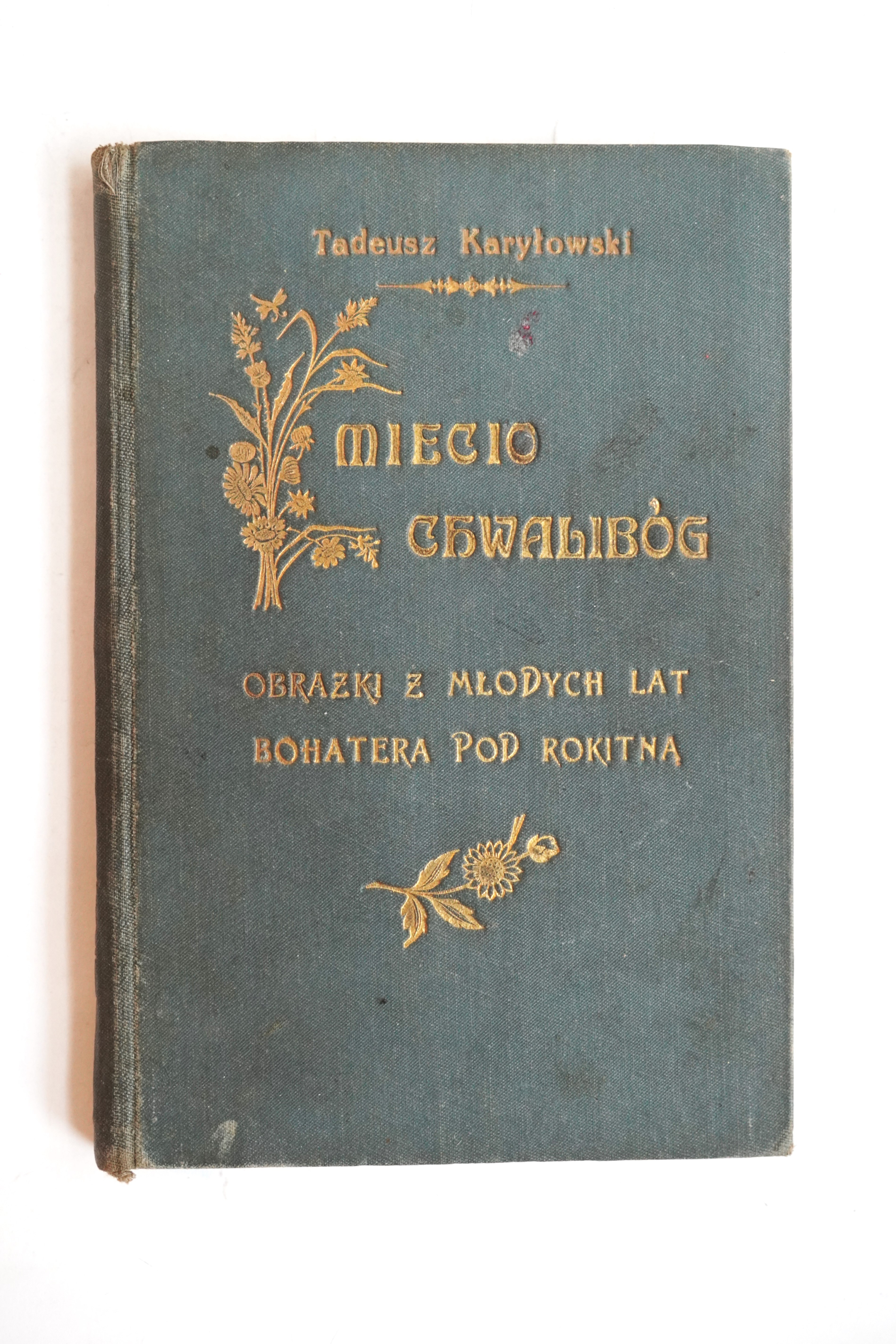
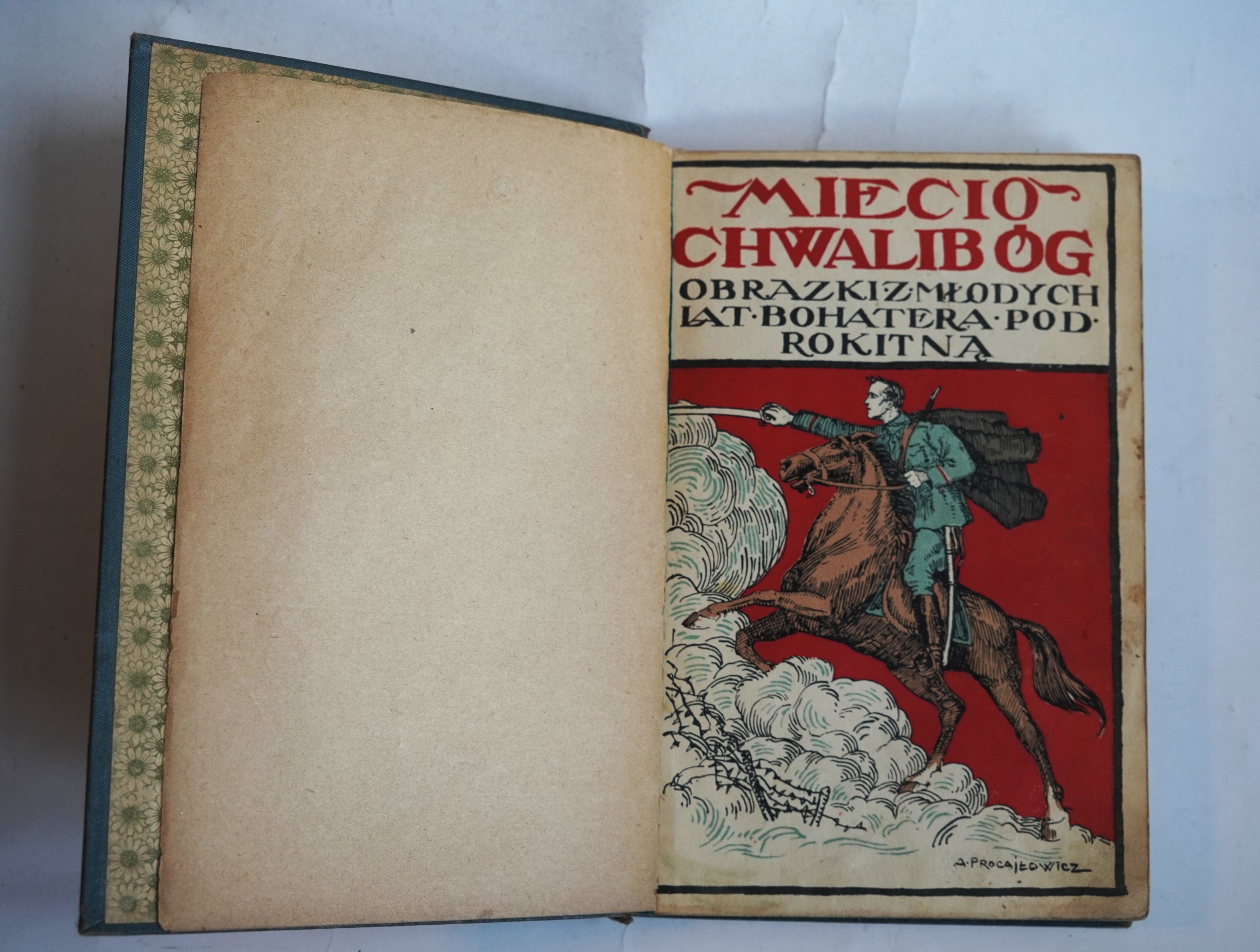
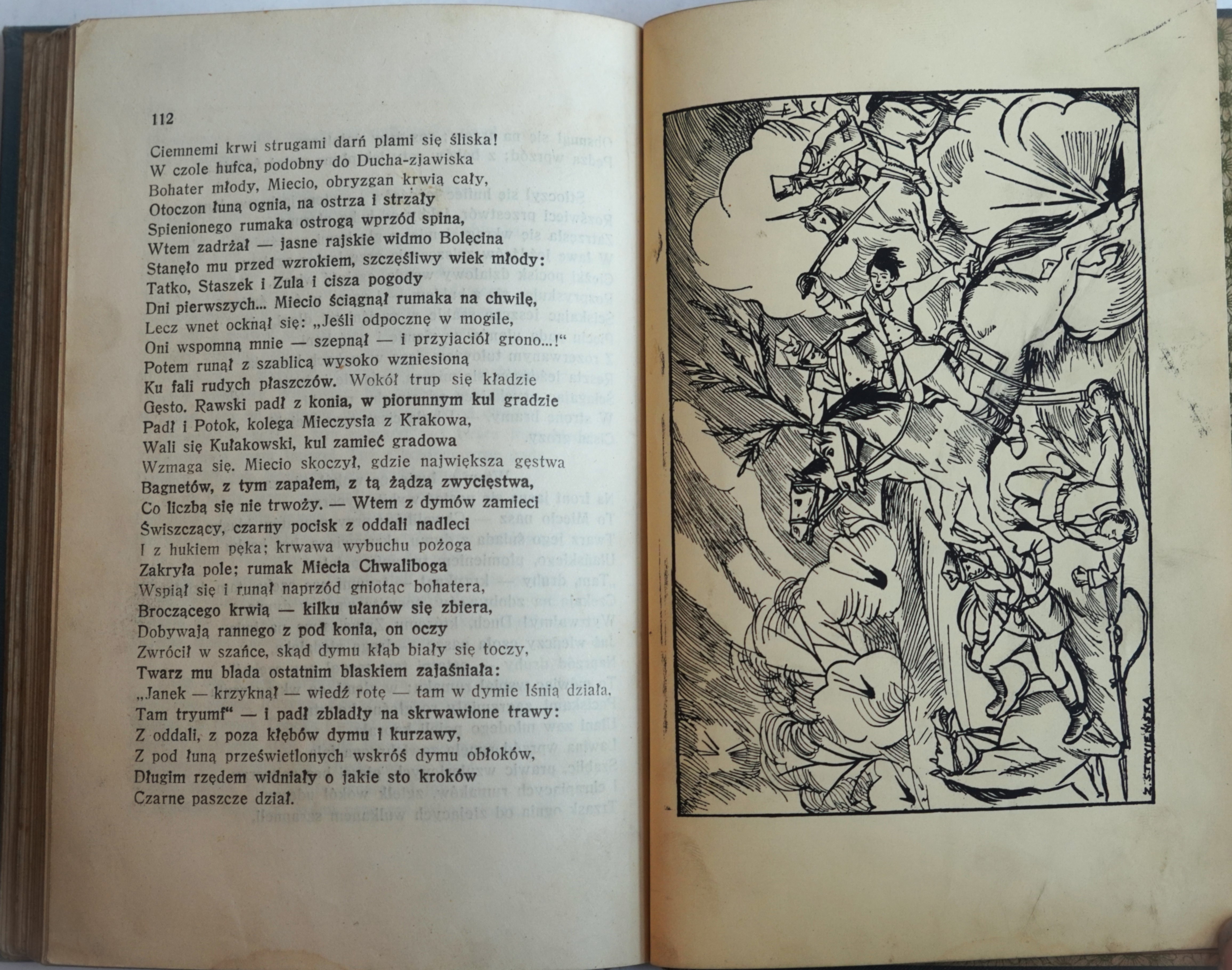
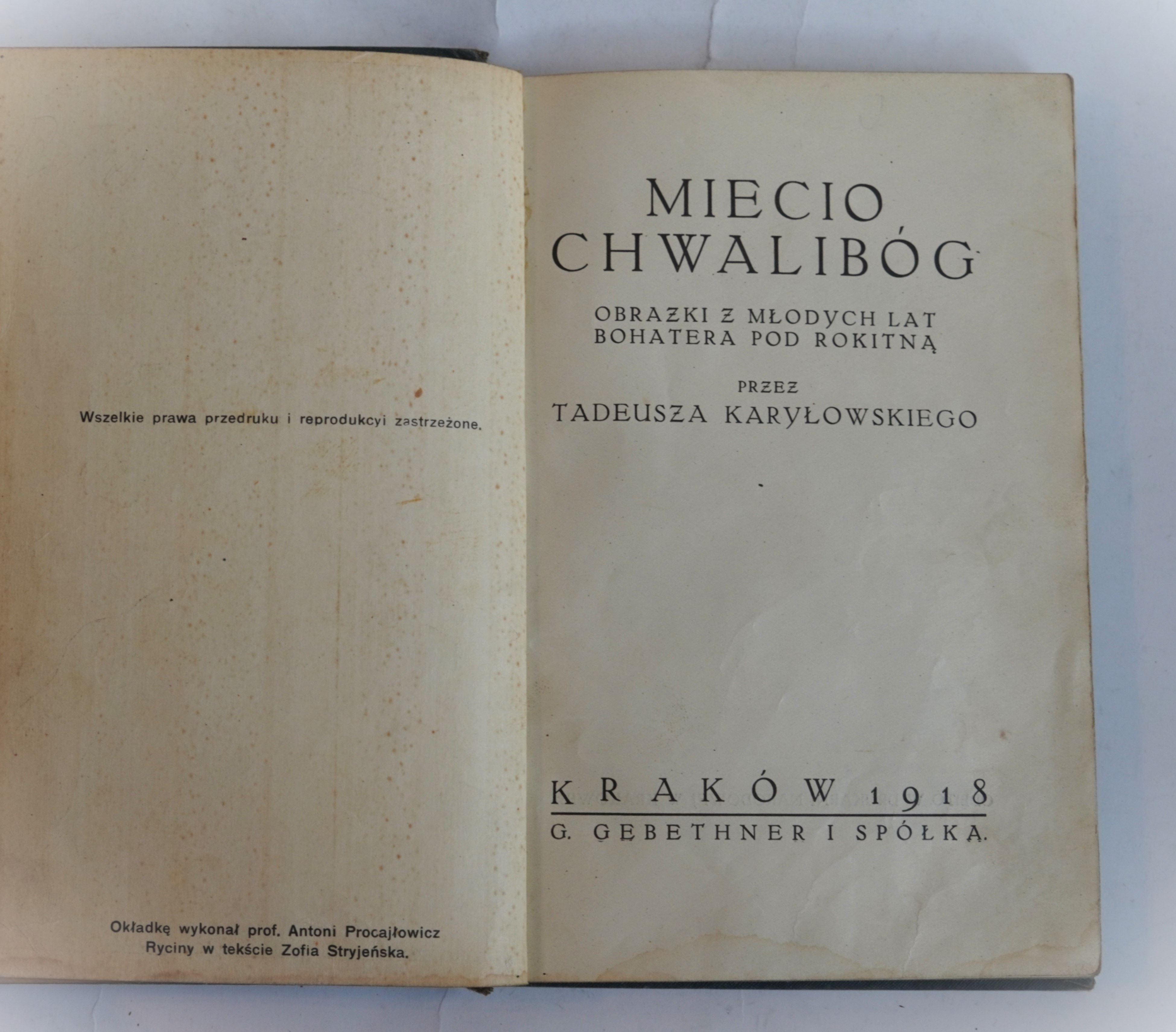
Tadeusz KYRYŁOWSKI, *Miecio Chwalibóg: Pictures from the Hero’s Early Years near Rokitna*. The cover of the booklet was designed by Prof. Antoni Procajłowicz.
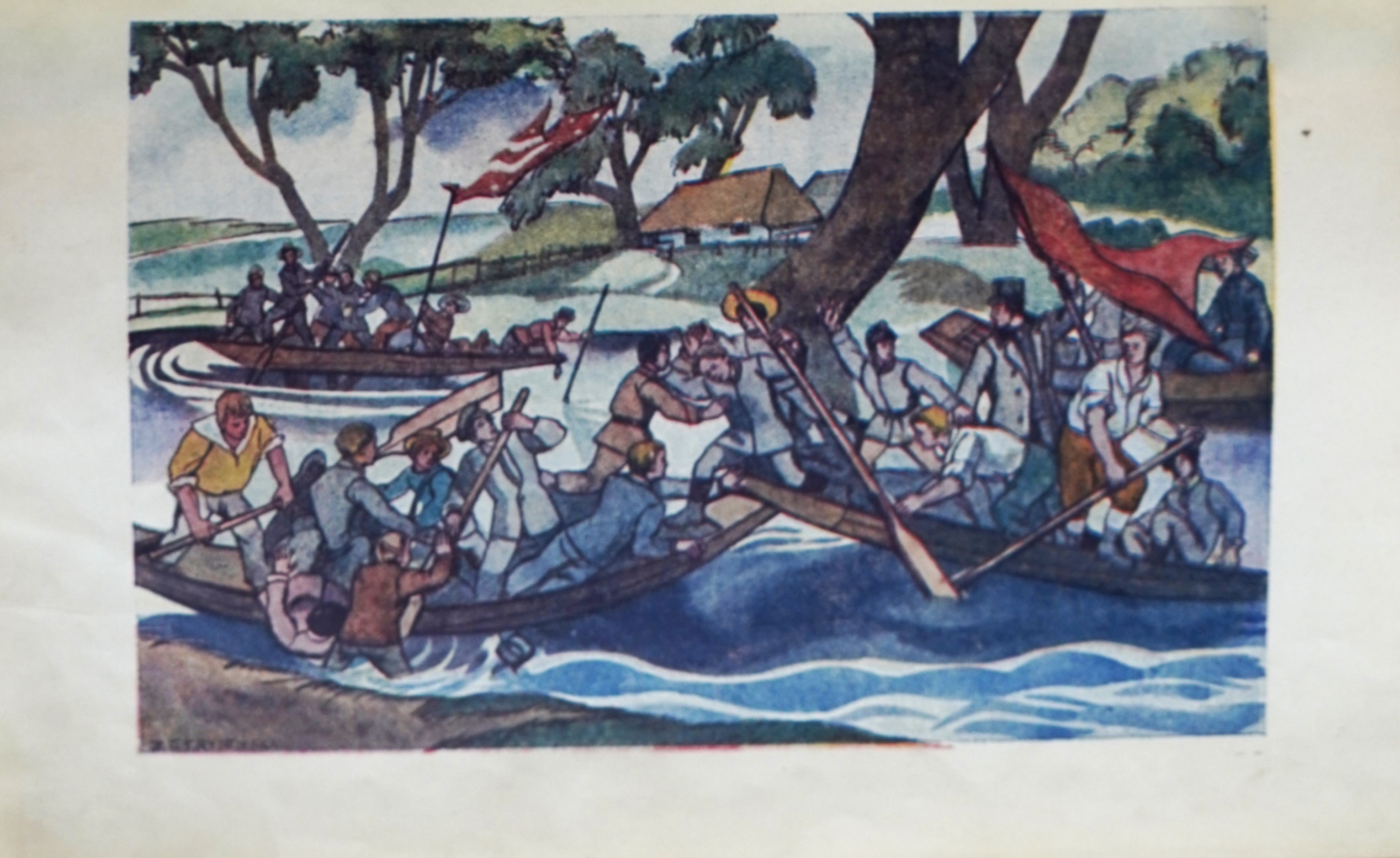
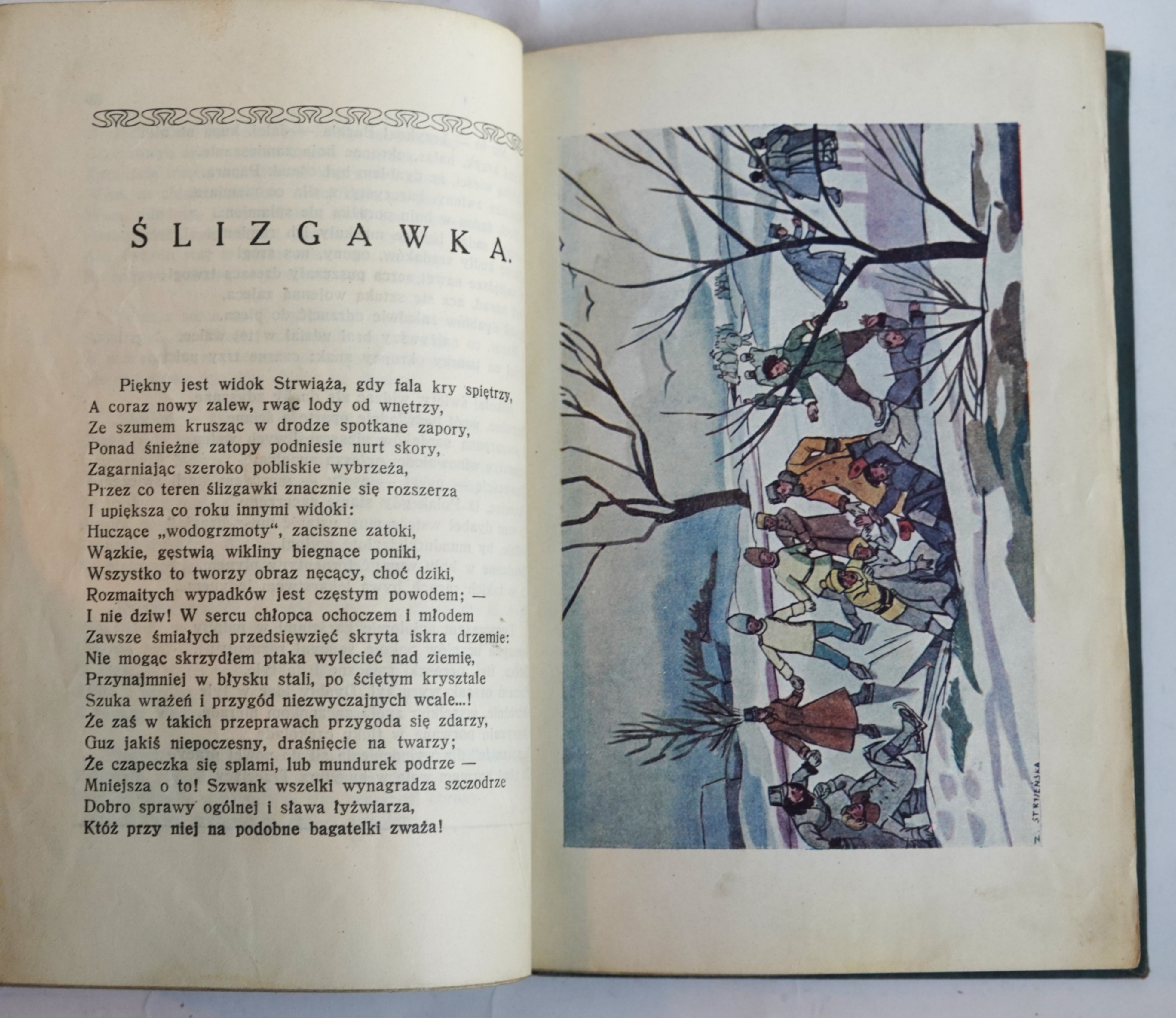
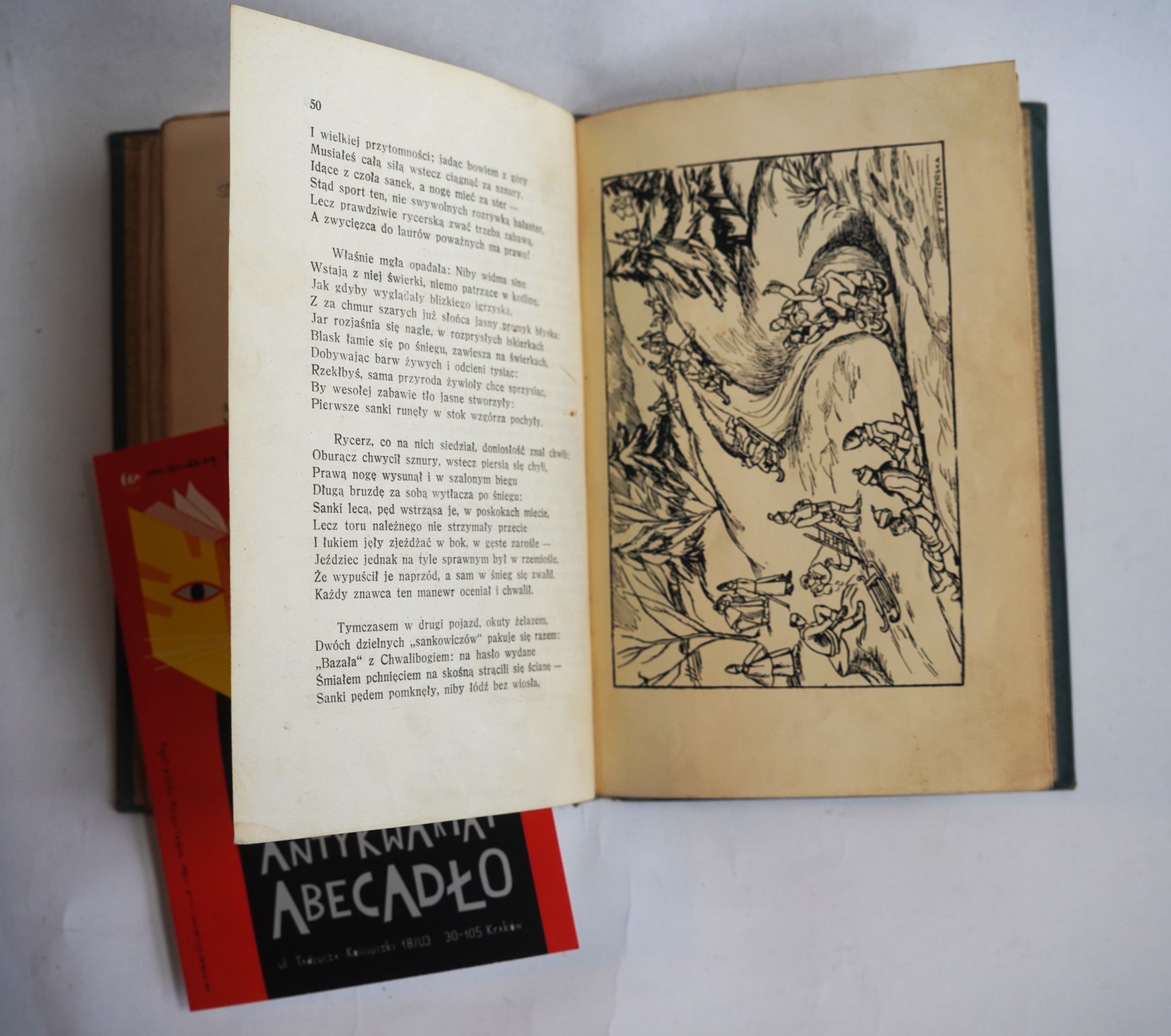
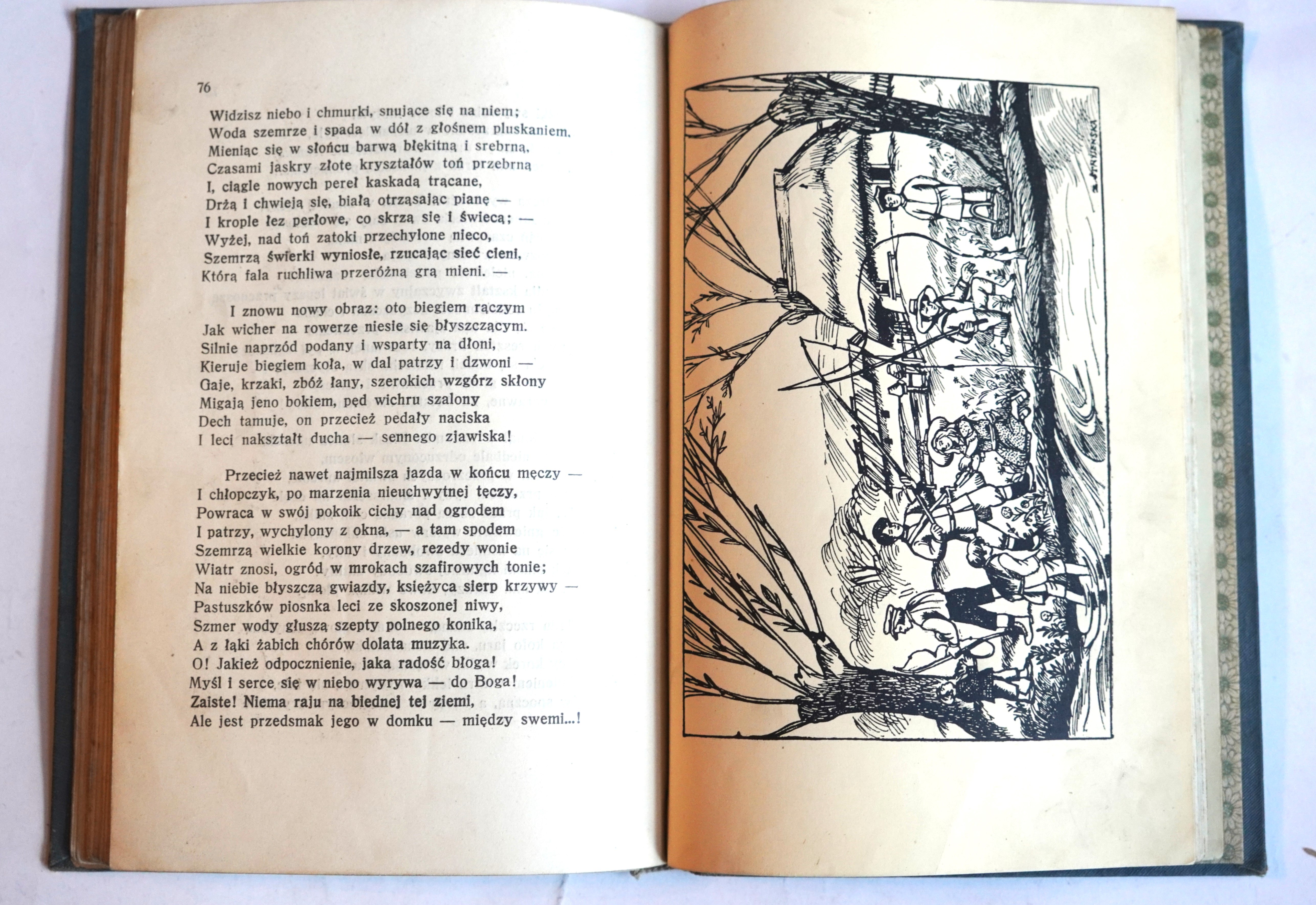
3 color illustrations and 17 black-and-white illustrations on plates by Zofia Stryjeńska!!!
Published in Kraków, 1918.
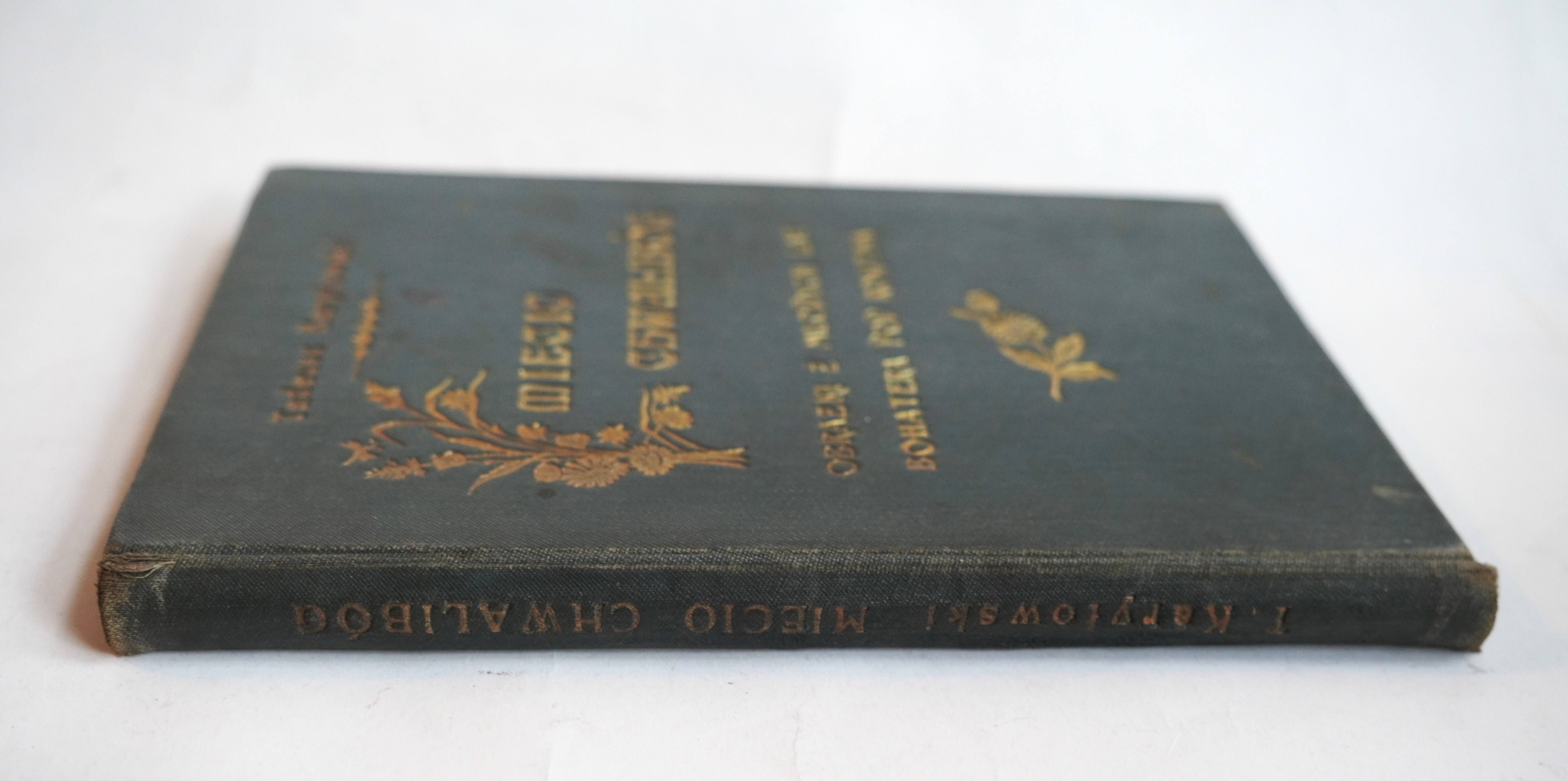
Gebethner & Co. An exceptionally ornate, hardcover bookbinder’s binding, with period embossing and gilding.
Number of Pages: 116; Dimensions: 18.6 cm x 13 cm.
Condition: good; one plate with a drawing by Zofia Stryjeńska, between pages 36 and 37, is detached from the text block.
According to Wikipedia:
Zofia Stryjeńska, née Lubańska[3] (born May 13, 1891, in Kraków; died February 28, 1976, in Geneva)—Polish painter, printmaker, illustrator, set designer, and representative of Art Deco.
Along with Tamara Łempicka, she was one of the most famous Polish visual artists of the interwar period.
Biography
From childhood, she drew and painted extensively. As a young girl, she began contributing to illustrated magazines (“Rola” and “Głos Ludu”). In 1909, she began her studies at Maria Niedzielska’s School of Fine Arts for Women in Kraków. She graduated in 1911 with honors in painting and applied arts. In 1910, she traveled with her father through Austria-Hungary to Italy, during which she visited galleries and museums in Vienna and Venice.
On October 1, 1911, posing as a man named Tadeusz Grzymała Lubański[4], she began studying painting at the Academy of Fine Arts in Munich (at that time, women were not admitted to the academy). A year later, after being recognized by her classmates, she left Munich and returned to Kraków, where she embarked on an intensive career in painting and literature.
In May 1913, in the pages of *Czas*, art critic Jerzy Warchałowski discussed Zofia Lubańska’s work at length, thereby bringing the young artist to prominence. At that time, she entered the circles of Kraków’s intelligentsia and bohemian community. She became acquainted with the Żeleński, Jachimecki, Puget, and Kossak families. She befriended Magdalena Samozwaniec and her sister, the poet Maria Pawlikowska-Jasnorzewska.
On November 4, 1916, she had a quiet wedding with Karol Stryjeński, an architect and lover of Zakopane. She had three children with him: a daughter, Magda, and twins, Jacek and Jan.
Stryjeński introduced his wife to his circle of friends, which included artists and figures from the literary world. It was then that she met, among others, Władysław Skoczylas, Henryk Kuna, Stefan Żeromski, Władysław Reymont, Witkacy, and later several poets from the “Skamander” group.
From 1921 to 1927, she lived in Zakopane, where her husband took up the position of director of the State School of Wood Industry in 1922. This period, initially happy and creatively fruitful, gave rise over the years to increasingly serious disagreements with Karol, and eventually to an open conflict that ended in divorce in 1927. Among other things, Stryjeński had her committed twice to a mental institution[5].
After the divorce, she moved to Warsaw, where in 1929 she married the actor Artur Socha (1896–1943). This marriage, too, proved unhappy: the painter worked herself to the bone to support herself, her children, and her husband—who shunned work—during the economic crisis. After a few years, she divorced him, only to enter into a brief relationship in the late 1930s with the architect and bon vivant Achilles Breza, and then with Arkady Fiedler, a traveler and writer already well-known at the time[6].
The mid-1930s were a difficult period for the artist, during which she received no commissions. Stryjeńska neither knew how nor was willing to seek recognition. She was not fond of the Sanacja regime ruling the country, nor did she align herself with any of the newly formed artistic or political groups.
Driven to despair by a lack of money, she sold several paintings to loan sharks. It was not until 1938 that she received several commissions from the Ministry of Foreign Affairs, including a kilim for Emperor Hirohito of Japan. She participated in the interior decoration of Polish passenger ships: the MS Batory and the MS Piłsudski. She also created the interior decoration for a room at E. Wedel’s confectionery in Warsaw. Once again, people began purchasing her paintings with Slavic and historical themes.
The artist spent the occupation in Kraków. When the Russians entered the city in early 1945, Stryjeńska decided to leave Poland[7]. After many twists and turns, she reached Switzerland, where her daughter was already living, and her two sons later joined her there as well. She attempted to leave for the United States: she applied for assistance from the Kosciuszko Foundation, but the Foundation’s Board of Trustees denied her requests. She lived in Geneva extremely modestly, generally refusing to accept help even from her sons. Emotionally attached to Poland and Polish culture, she was unable to find her place in a foreign country. She died in Geneva and was buried in the cemetery in Chêne-Bourg.











