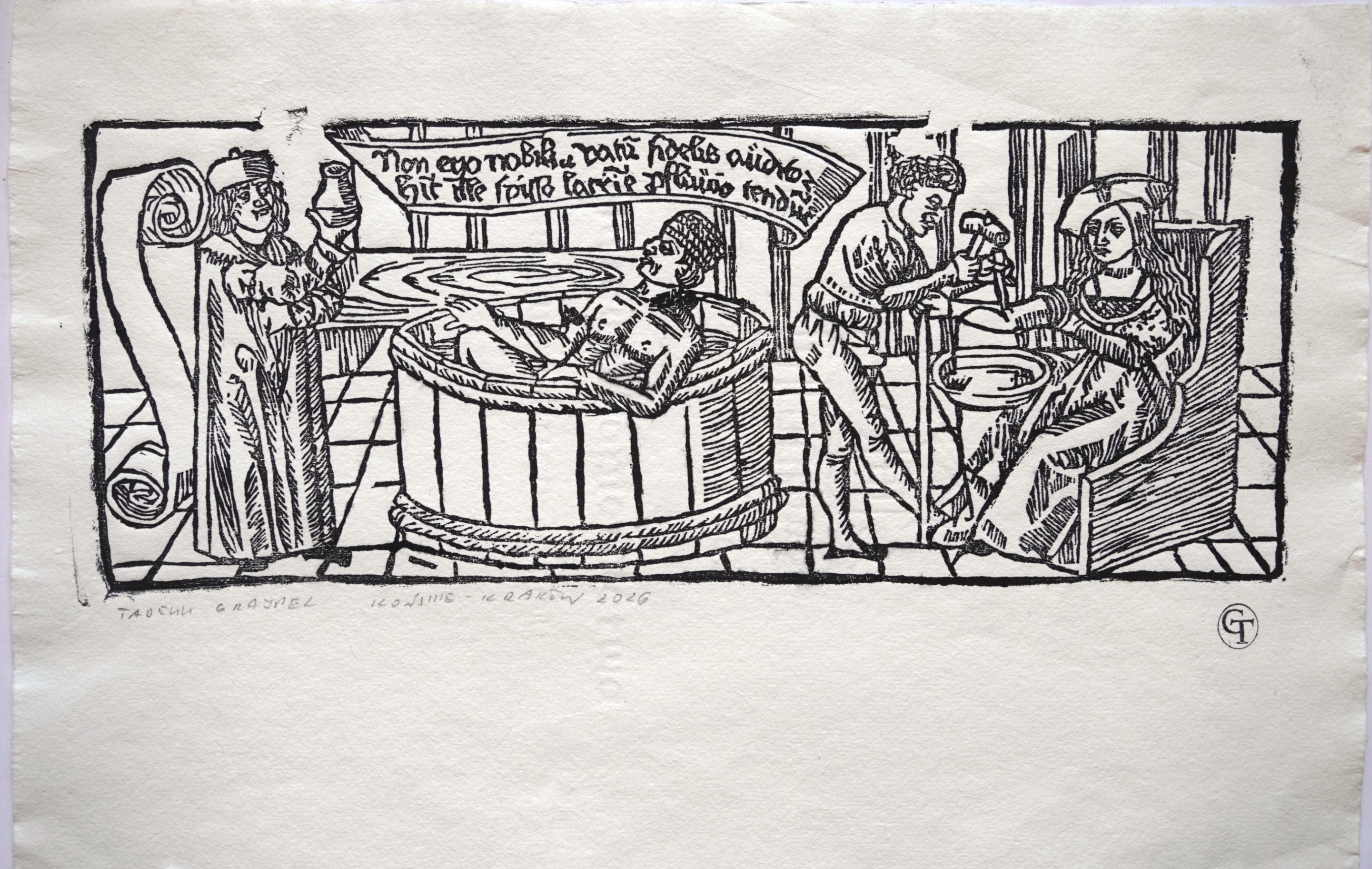
Medical Calendar, Jan Haller, Kraków, 1508, woodcut on handmade paper; dimensions: print 11 x 27 cm, sheet 21 x 30 cm; replica carved in linden wood by Tadeusz Grajpel, printed from the block using traditional methods, GT stamp (Tadeusz Grajpel), hand-signed and labeled in pencil by Tadeusz Grajpel.
Jan Haller (German: Johann Haller; born 1467 in Rothenburg ob der Tauber, died 1525)—bookseller, owner of a printing house in Kraków from 1505 to 1525 and a paper mill in Prądnik Czerwony, as well as a merchant dealing in wine, beer, and olive oil. In 1506, he printed the Statute of Łaski on parchment. It was the first official publication in Poland to be printed. In 1508, he published the first printed book in the Polish language: *The Story of the Passion of Our Lord Jesus Christ*. He published approximately 300 books of the highest editorial quality. Among other works, he printed the writings of Erasmus of Rotterdam and Nicolaus Copernicus’s debut as a translator—a Latin translation from the Greek of a collection of 85 fictional letters by the 7th-century Byzantine historian Theophylact Symocatta.
Tadeusz Grajpel on his work:
Tadeusz Grajpel, (born in 1955)—I live in Końskie, where I founded and have run since 1994 my own workshop dedicated to recreating historical technologies related to the history of documents, books, and woodcuts. For over a dozen years, this has been the Workshop for Historical Research and Education.
Back in the last century, I built the country’s first replica of a Gutenberg printing press intended for public education. It remains in operation to this day in accordance with historical realities, naturally using lead type. It is used for a wide range of educational activities on the history of printing, as well as for printing various short source texts and bibliophile editions. For over 30 years, historical woodcut printing has also been a complementary element in my research on early printing; I study and reproduce these works both technically and analytically. Today, this is my primary focus; I have already carved over 700 research replicas of historic printing blocks. I began with several dozen objects of the oldest provenance and usage, ranging from fabric printing from the dawn of civilization to the present day. In this way, I sought the source of the skills possessed by the woodcut artists of medieval Europe, who produced an incredibly rich and ever-growing collection of blocks for printing on paper. These were used to illustrate incunabula, old prints, various loose prints, and many other ways in which woodcut prints were utilized in everyday life. To date, I have carved approximately 150 medieval blocks, and the work is ongoing.
While researching Renaissance books, I have recreated several hundred blocks from old prints of all origins. Of course, these include both our Kraków university textbooks and works from all over Europe at that time. In all existing variations of use and diverse subject matter: science, religion, politics, and entertainment. There are over 500 of them, and more are being created.
I create all woodcuts with the utmost historical fidelity to the original techniques. These are copies—replicas of original prints from the medieval, Renaissance, and Baroque periods. These were the times of “langowe” woodcuts, or longitudinal woodcuts. They were carved, not engraved—contrary to the misleading name of the much later cross-cut woodcut technique. This is manual work, as close as possible to the original technique, using traditional methods. First, I transfer the historical print from a selected source onto a prepared block. This, incidentally, was a common practice for hundreds of years, with various approaches. This is the only stage where, for obvious reasons, I use digital copies to ensure fidelity to the original. The block is carved by hand. I cut out every line of the print using appropriate scalpels. Chisels are used only to carve out larger areas, such as the background. The printing block carved in this way is, of course, used—just as in the past—for printing. To make the prints, I use exclusively handmade paper from the Museum of Papermaking in Duszniki-Zdrój, complete with watermarks. The printing process is also done by hand, involving soaking, pressing, drying, and ironing—exactly as in historic print shops. Several hundred carved blocks and the prints on display have also served for many years as a foundation for a wide range of educational activities, including workshops, museum and library exhibitions, bibliophile publications, lectures, and demonstrations aimed at popularizing knowledge about the history of books and printing. These activities also include classes for students at the Jagiellonian University and many other Polish universities. In Kraków, I have also been collaborating for years with museums and cultural institutions: the National Museum, the Museum of Kraków, the National Museum, the UNESCO City of Literature, KBF, the development of a trail tracing Kraków’s historical printing heritage, and many other outreach initiatives and exhibitions. The studio’s body of work also includes over 30 years of similar educational, museum, and outreach projects throughout the country and abroad; listing even a few dozen of them would likely be impossible and inappropriate. However, there is something I consider particularly important and worth noting. I have the honor, as Brother Woodcutter, of being a member of the chapter of the White Raven Knights’ Order of Bibliophiles, based in Kraków.