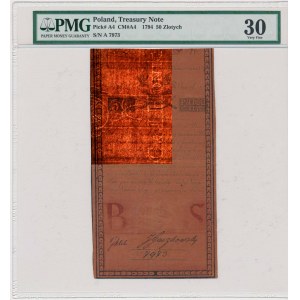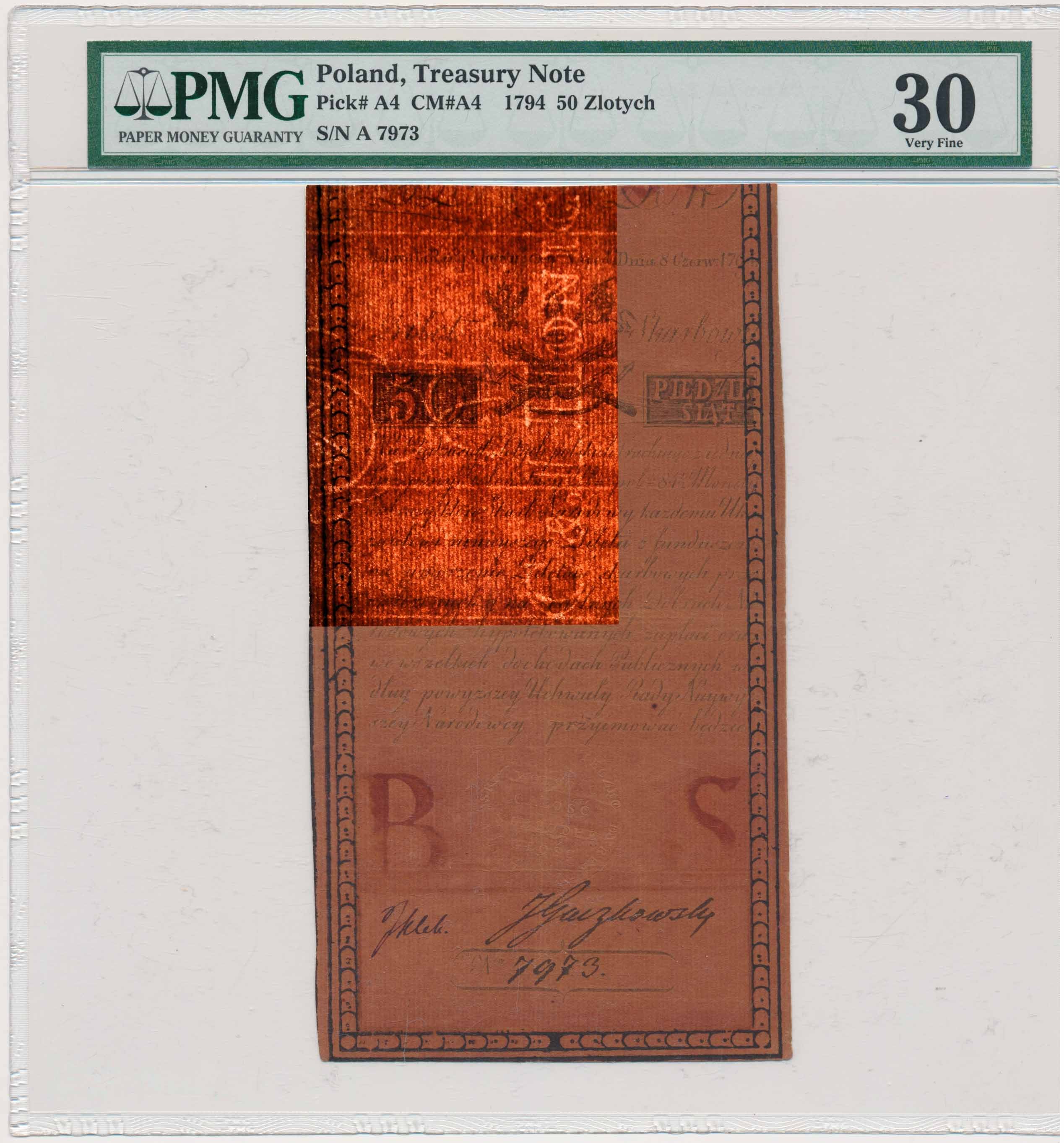


Piece printed on extremely thin paper, quite different from most 50-zloty banknotes. This is a characteristic feature of banknotes printed on paper with the rare C.I. HONIG filigree. Offered piece with a magnificent and most prized watermark inscription piece and coat of arms element. Marked with series A and a low four-digit serial number, which allows us to assume that this paper was used for the printing of the first sheets.
A very nicely preserved piece. Due to the thin and delicate paper used for printing, the banknote is difficult to acquire in nice states of preservation. Typical for banknotes printed on thin paper, a burn from the ink where the commissioner's signature was applied, and a relatively low relief dry seal, which is also indirectly caused by the paper weight used for printing. A few fractures in the field, but the edges are smooth with no cuts. Considering the weight of the paper used for printing, this is a piece in very attractive, definitely above average condition.
The piece on offer is a rare long Kosciuszko ticket. Rare because of the paper used for printing with the C.I. HONIG. watermark, which is many times rarer than the three "typical" watermarks we can find on long tickets. While this is not an unknown item from auction listings, over the past few years only individual listings are known, mostly from our auctions.
A banknote for advanced collections, a much-loved issue from the period of the Kosciuszko Insurrection. An item undoubtedly for specialized collections!
In the Polish lands, the introduction of paper money into circulation was connected with expenses related to the outbreak of the Kosciuszko Insurrection. Its issuer was the Directorate of Treasury Tickets established by the Supreme National Council. In terms of value, treasury tickets were equated with coinage. Obligations to the Treasury could be paid a maximum of 50% in paper money and the remainder in coins. This condition resulted in its negative reception by the public. In the future, the redemption of treasury tickets was to be financed from national wealth. For counterfeiting paper money, the death penalty was stipulated, as well as confiscation of all the perpetrator's property. On September 29, 1794, in order to strengthen confidence in treasury tickets, the National Supreme Council authorized the regulation of the entire amount in paper pennies and zlotys. Due to the failures of the uprising, public confidence in paper money was declining. The population preferred to accept bullion money in settlements. The range of issuance of the first Polish paper money was small - it was introduced on a large scale only in Warsaw. After the capture of the capital on November 6, 1794, tickets of all denominations for a total of 7.8 million Polish zlotys remained in the hands of the population.
On June 8, 1794, the Supreme National Council passed a resolution establishing an issuing institution - the Directorate of Treasury Tickets - and introducing treasury tickets in denominations: 5, 10, 25, 50, 100, 500 and 1000 Polish zlotys. Treasury tickets with an issue date of June 8, 1794 are very similar. They are one-sided printings in the form of a standing rectangle differing only in color and border detail. Each denomination was hand-numbered and signed by two or three representatives of the Treasury Ticket Directorate. In addition, each ticket bears the dry seal of the Treasury Ticket Directorate.
After printing, paper money of equal denomination was stapled together in the form of a cloth-bound "booklet." When they were put into circulation, they were hand-cut from them by which tickets of the same denomination differed in size and in the shape of the top edge. The part that remains in the "booklet" and the coin released into circulation have the same number.