


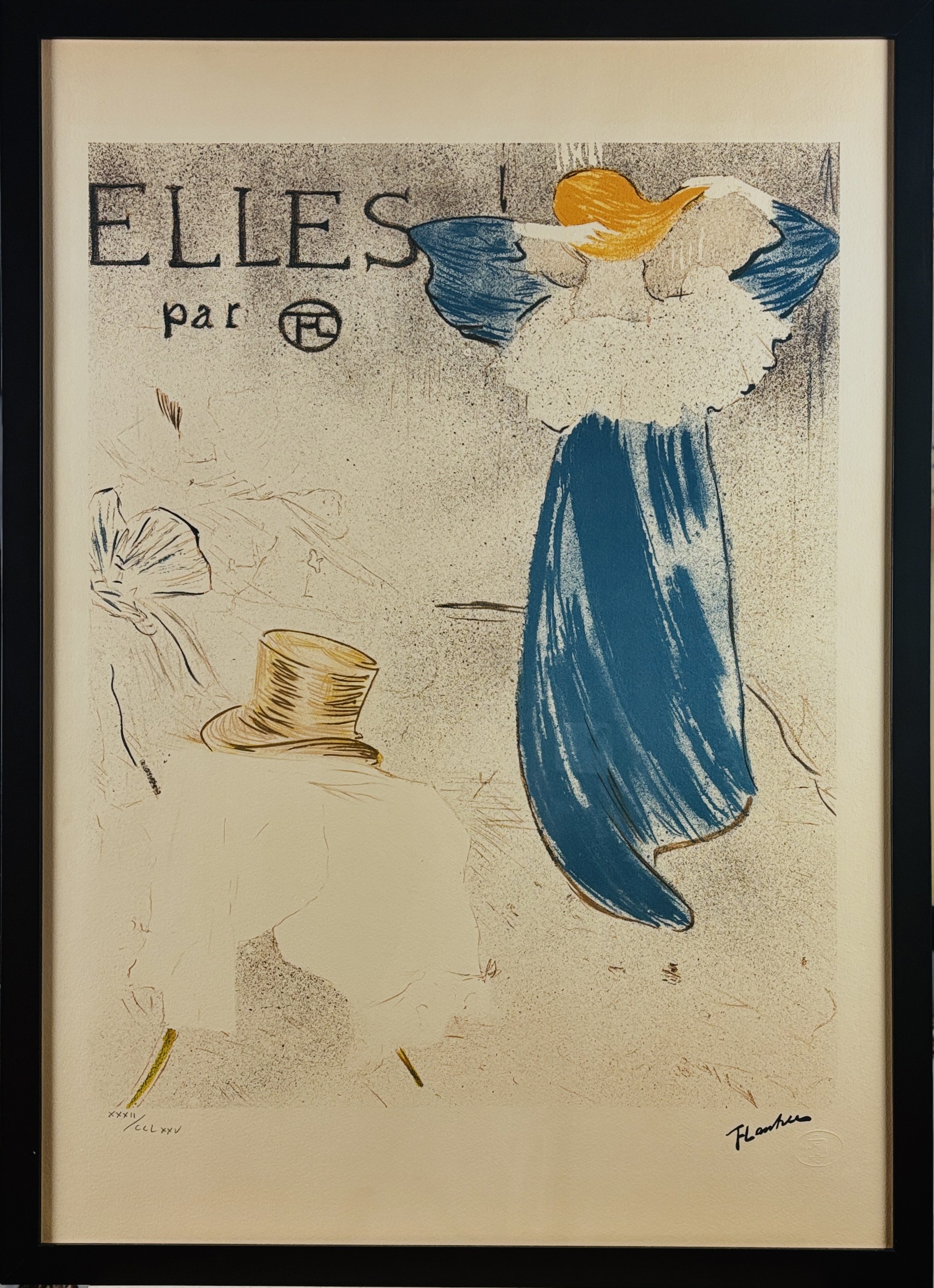
Collector's lithograph, museum-certified, on Arches Velin paper, framed in a frame measuring 80 x 58 cm;
Limited edition, numbered XXXII/CCLXXV on the left;
Artist’s signature from the seal on the lower right, dry seal “MUSÉE TOULOUSE-LAUTREC · ALBI” on the lower right
Edition authorized by the artist’s museum in Albi
Original composition: 1896, Elles, Delteil 182 / Adhémar 200 / Wittrock 158.
Provenance: private collection.
Frontispiece, i.e., the title page of the *Elles* portfolio. The original composition was created in 1896. It is one of the most recognizable works in the entire portfolio.
Toulouse-Lautrec created a series of 12 works for the *Elles* portfolio commissioned by Gustave Pellet, who was one of the most important Parisian publishers of erotic prints in the late 19th century. The commission focused on the lives of women working in Parisian brothels.
Toulouse-Lautrec knew this milieu very well. Between 1892 and 1895, he frequently visited Parisian maisons closes, including those on Rue des Moulins, Rue d’Amboise, and Rue Joubert. However, he did not treat the subject as a typical erotic illustration, as the client had expected. Instead, he depicted the women engaged in everyday, private activities: resting, washing, combing their hair, getting dressed, or waiting for clients. Pellet likely hoped for commercial success among consumers of erotic prints, whereas Lautrec created a work that is exceptionally intimate and devoid of explicit eroticism.
The lithograph on offer is a frontispiece, that is, the opening plate of the portfolio. It is particularly interesting because it shows a woman not in an erotic situation, but in a private and almost everyday moment. We see her from behind as she adjusts her hair. A man’s top hat lies nearby, suggesting the presence of a client, but the man himself remains out of frame. The Cleveland Museum highlights this very top hat as a symbol of the male client’s presence.
This is very characteristic of the entire concept behind “Elles”: Lautrec depicts the world of prostitutes from their own perspective, rather than from the client’s point of view.










Laatst bekeken
Log in om de kavellijst in te zien
Favorieten
Log in om de kavellijst in te zien