


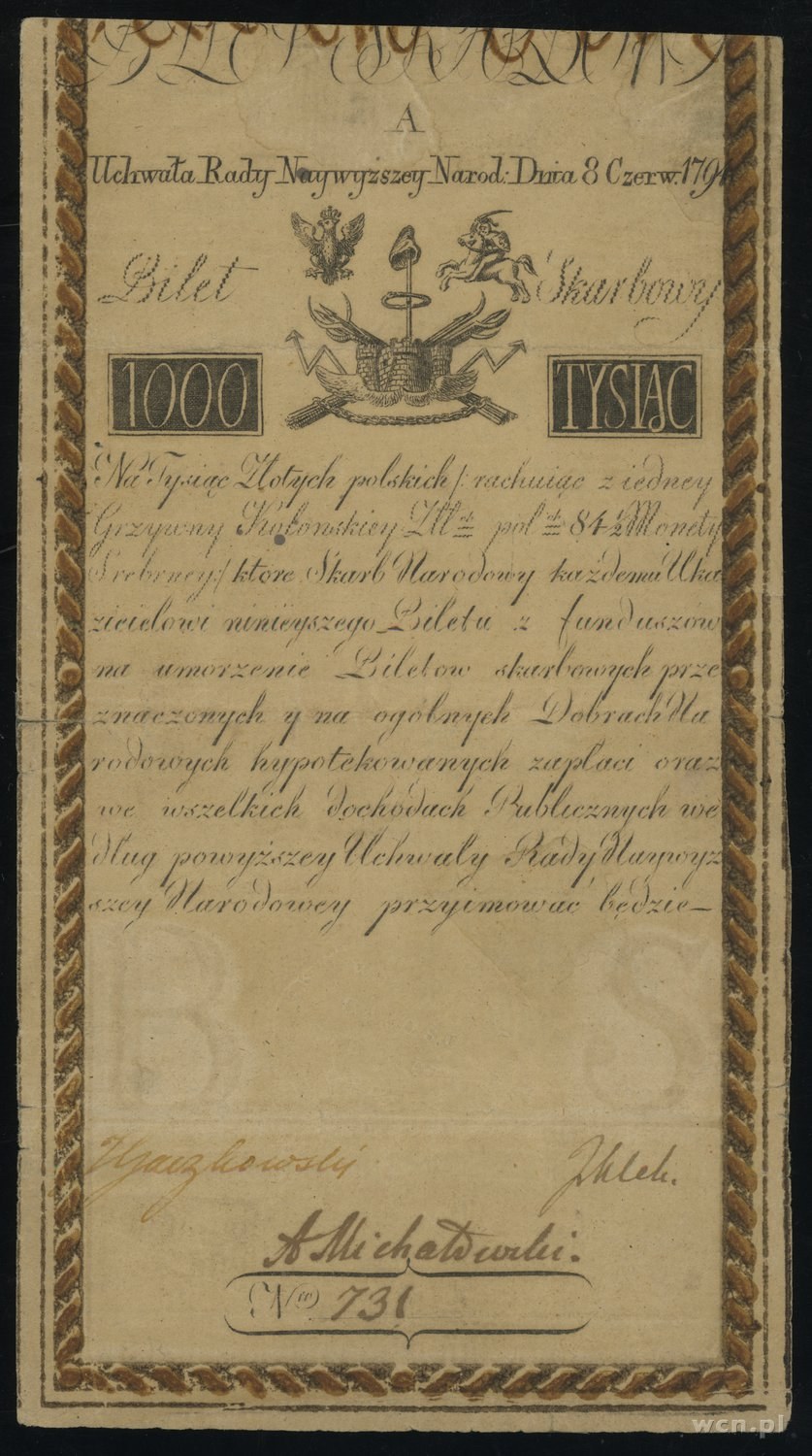
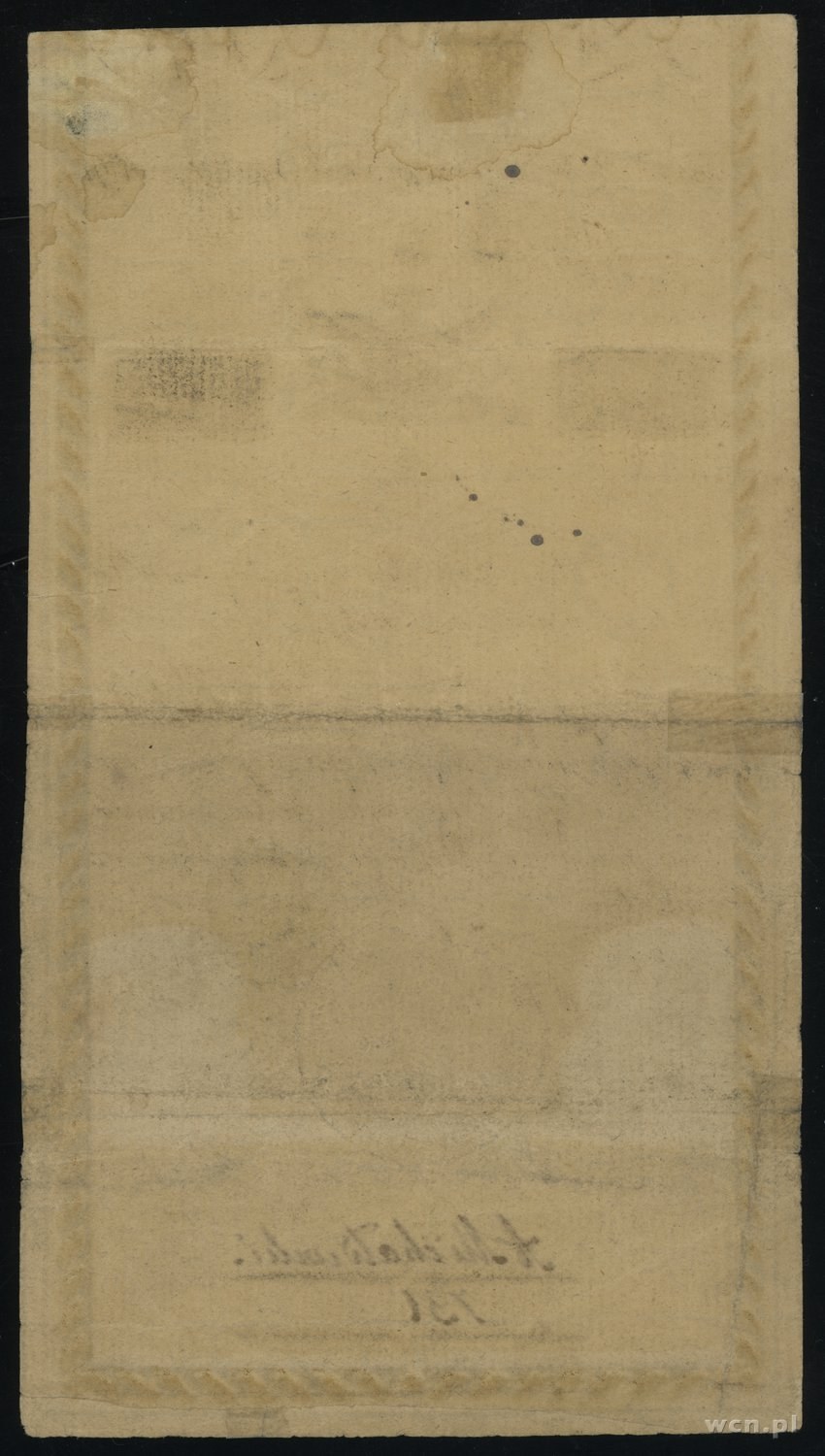
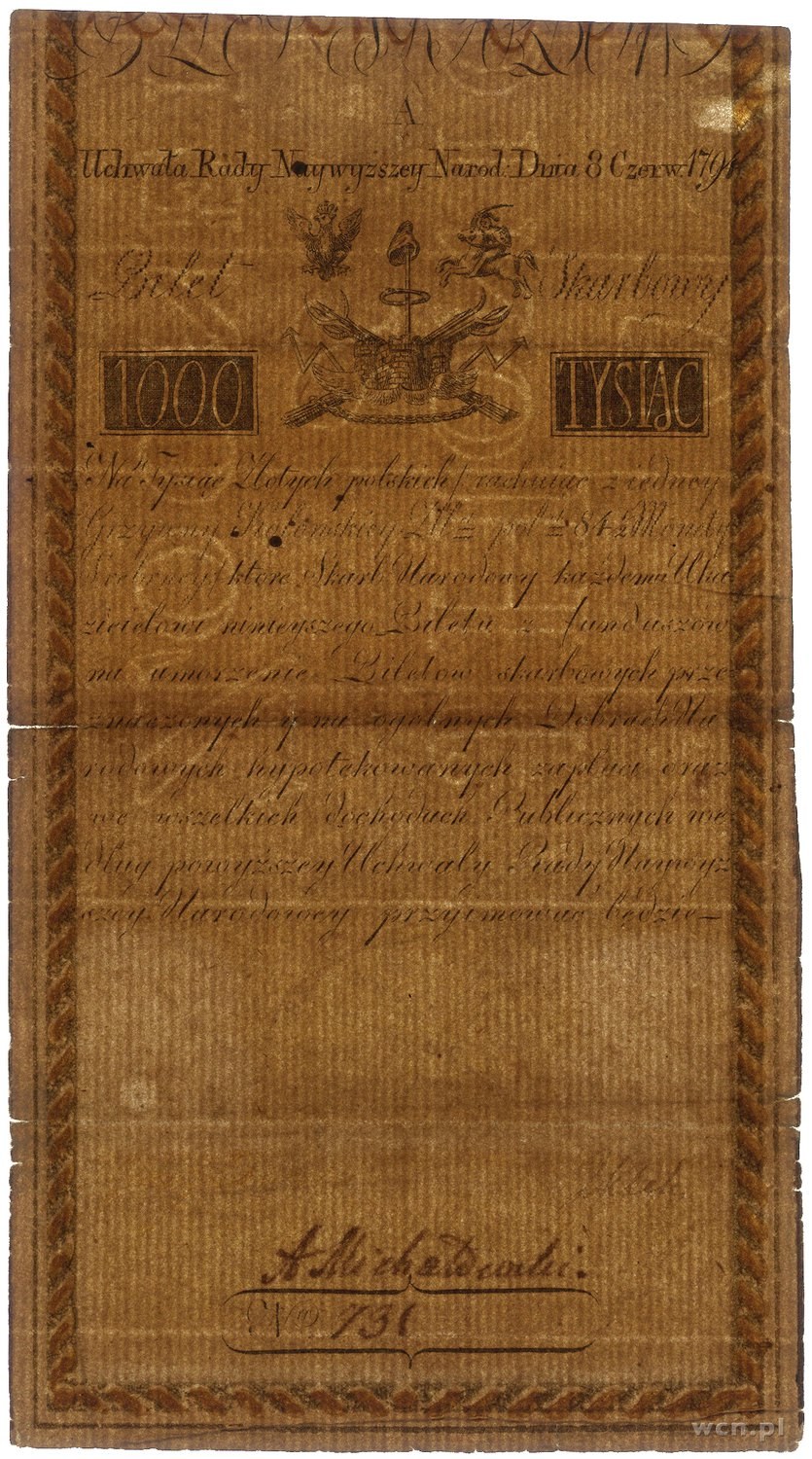
Kosciuszko Insurrection (1794), 1,000 Polish zloty, 8.06.1794; series A, numbering 731, well visible watermark J.Honig / Zoonen; Lucow 37 (R7) - but in the catalog the bill without the watermark, Miłczak A7; fractures horizontally, understickers on them, paper soiling and discoloration, paper defects on the upper margin, bill in good state of preservation, extremely rare, legendary denomination of banknotes from the period of the Kościuszko Insurrection, with a full, inscribed element of the watermark J. Hoonig & Zoonen, a rarity among Polish banknotes, an ornament of the largest collections.
Troubled by the consequences of the Bargain Confederation established in 1792, the Republic of Poland stood at the threshold of collapse. Bankruptcy was declared by the largest banks on its territory at the time. The difficult situation, triggered every now and then by the tugs of war between political factions, finally had to bring about changes. After the second partition of Poland by Russia and Prussia, the conspirators began preparations for an uprising. On March 24, 1794, the insurrection, known as the Kosciuszko Uprising, began in the Polish territories. In order to stabilize the monetary situation, the Supreme National Council - at the urging of the uprising's dictator Tadeusz Kościuszko - undertook a reform aimed at introducing paper banknotes to the Polish lands.
It is difficult to clearly identify the author of the law that was created at that time, although the names of Andrzej Kapostas - a member of the Directorate of Treasury Bills - are most often mentioned, and sometimes Hugo Kołłątaj - one of the founders of the May 3 Constitution.
On June 8, 1794, the Supreme National Council passed a resolution establishing the Directorate of Treasury Tickets. In the pages of Gazeta Warszawska (Warsaw Gazette) on the same day, news of the issuance of treasury tickets appeared. The established denominations started at 5 zlotys and ended at 1,000, and the size of the issue was set at 60 million Polish zlotys. Printing was to be handled by the Warsaw printing house of Jan Abraham Willing. Execution of production rested in the hands of the Directorate of Treasury Tickets officiating at the Raczynski Palace on Dluga Street in Warsaw. The production of copperplate matrices was supervised by printer Karol Michal Gröll. Printing paper was imported from the Dutch manufactures J. Honig & Zoonen, Pieter de Vries & Comp., C & I Honig, D & C Blauw.
Tickets of specific denominations were signed by commissioners appointed from among merchants and city officials. The banknotes of the 1,000 zloty denomination bear the signatures of Jan Klemens Gaczkowski and Jan Klek - Warsaw merchants - and Antoni Michałowski - revisor of the Szulecka chamber.
Karol Michal Gröll was the designer of the Eagle and Pogo and the symbol of freedom, which included the Phrygian cap, the armament of the Sankiulots (the poor and also the most radical participants in the French Revolution), the basque, peoples' thunders, chains, and the wings of freedom. The banknotes also had security marks to prevent counterfeiting. These were the capital letters B and S (an abbreviation of the phrase "treasury ticket"), as well as - added in relief printing - special borders: different for each denomination. The originator of these security features was the aforementioned Kapostas, and his consultant and executor was the well-known chemist Jan Frederick Zejdl.
No less important of the security features, was - embossed between the aforementioned letters in the lower part of the ticket - a dry stamp bearing the inscription "Seal of the Directorate of Treasury Tickets" and also the slogan "Freedom Whole Independence."








Laatst bekeken
Log in om de kavellijst in te zien
Favorieten
Log in om de kavellijst in te zien