


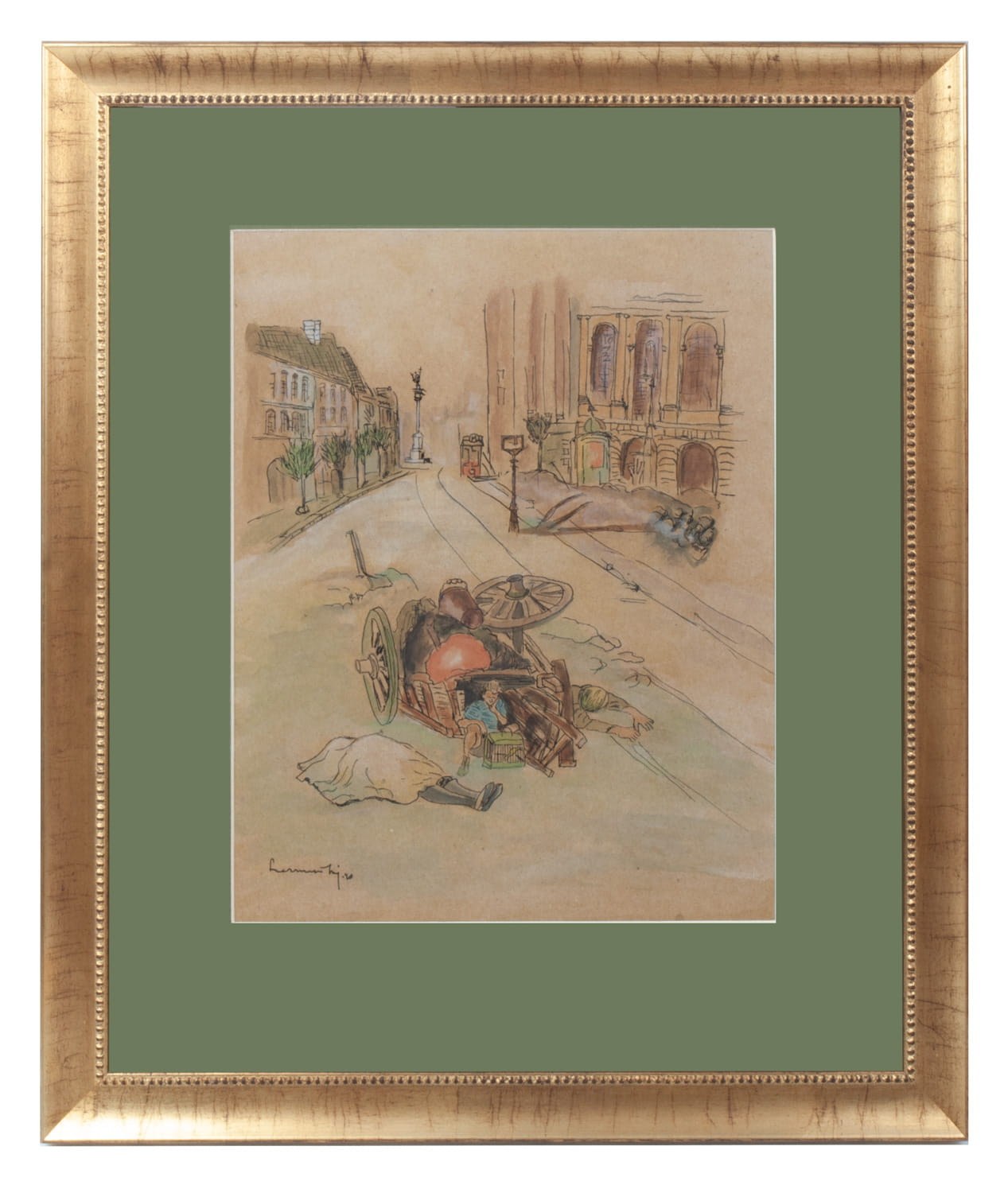
Pen, ink, and watercolor on paper, signed lower left “Czermański.”
Dimensions in frame: 45x38 cm (28x22 cm)
Zdzisław Czermański (Kraków 1900–1970 New York) – Polish graphic artist, caricaturist, painter, memoirist, and a member of the Polish Legions and an officer in the Polish Army. He was born into a family of actors. Even before World War I, he became involved with the riflemen’s movement in Lviv. In August 1914, he joined the Polish Legions. After the Oath Crisis of 1917, he was assigned to the 3rd Infantry Regiment and fought in its ranks at Rarańcza. The unit openly protested against the Treaty of Brest-Litovsk. After the war, he joined the newly formed Polish Army and fought in the Polish-Bolshevik War. In 1928, he left the army with the rank of captain. Starting in 1920, he published caricatures of political figures in the weekly *Szczutek*, and later also in *Cyrulik Warszawski*. His caricatures were free of malicious distortions and were well-received by the people he portrayed. Józef Piłsudski ordered 13 of his caricatures to be hung on the walls of the Belvedere Palace. From 1923 to 1924, he studied drawing and painting under Kazimierz Sichulski at the Municipal School of Industry in Lviv. In 1925, he left for Paris, where he continued his studies under Fernand Léger. In 1930, a solo exhibition of his works was held at the Charpentier Gallery. From France, he moved to England, where he drew for the magazine *Graphic*, and in 1931 he traveled to the United States at the invitation of *Fortune Magazine*, with which he collaborated until 1934. In 1935, he returned to Poland and began collaborating with *Wiadomości Literackie*. In 1939, he organized the exhibition “100 Great Poles” at the pavilion of the Institute of Art Propaganda. At the start of World War II, he traveled through Vilnius, Scandinavia, France, Portugal, and Brazil, eventually arriving in New York in 1941. He resumed his collaboration with *Fortune* as well as the magazines *Look* and *Life*. He published a volume of memoirs titled *Kolorowi ludzie* (*Colorful People*). Toward the end of his life, he created a series of 50 portraits of world figures, which was purchased by the University of Texas at Austin. He was active in the American Polish community and collaborated with Jan Lechoń, among others. He was the recipient of the Alfred Jurzykowski Award and the Polish Writers’ Association Abroad Award in 1966.











