


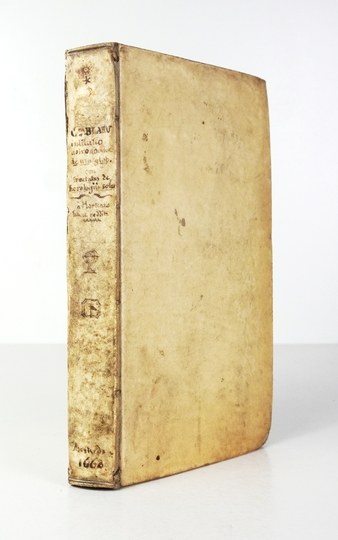
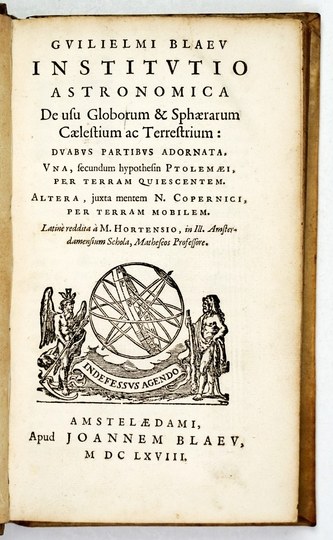
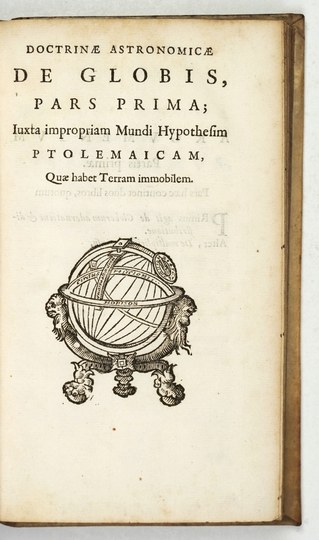
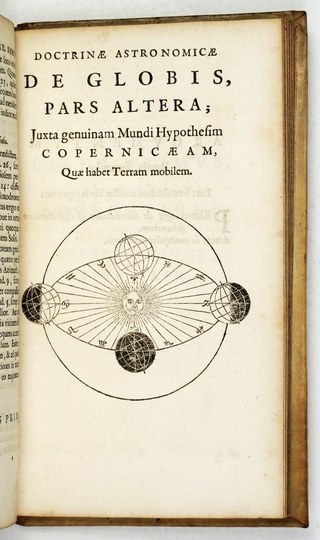
BLAEU, Willem Janszoon—Gvilielmi Blaev, *Institvtio Astronomica De usu Globorum & Sphaerarum Caelestium ac Terrestrium*: in two parts, the first of which, according to Ptolemy’s hypothesis, is based on a stationary Earth. The other, according to the views of N. Copernicus, with the Earth in motion. Translated into Latin by M. Hortensius. Amsterdam 1668. Published by Johannes Blaeu. 8vo, pp. [16], 243. Contemporary parchment binding.
Spine slightly cracked, corners of the cover scuffed; otherwise in good condition. A work by Willem Janszoon Blaeu (1571–1638), a Dutch cartographer, creator of maps and globes as well as astronomical works, and a student of the Danish astronomer Tycho Brahe. The work explains the construction and use of terrestrial globes and celestial globes, as well as spheres and sundials. The first part discusses topics according to the Ptolemaic system, and the second according to the Copernican system. Blaeu, a supporter and promoter of Copernicus’s ideas, was the first to construct a sphere in accordance with the system proposed by the Polish astronomer. Blaeu also initiated, on the occasion of the 75th anniversary of Copernicus’s death, the preparation for print of the third edition of of Nicolaus Copernicus’s *On the Revolutions of the Celestial Spheres*, which he annotated, corrected the errors and typographical misprints of previous editions, and to which he added a eulogy and a brief biography of the astronomer. The treatise presented here, one of the first to openly defend the Copernican system, was translated into Latin by Martinus Hortensius, a scholar who made a significant contribution to the dissemination of Copernican astronomy. In his introduction, he proposes a completely new way of explaining the heliocentric system using a system of globes. The book is adorned with numerous woodcuts that also serve to illustrate its content.











Laatst bekeken
Log in om de kavellijst in te zien
Favorieten
Log in om de kavellijst in te zien