Very rare municipal gold issue struck at the Wrocław (Breslau) Mint in 1528, during the early years of the reign of Ferdinand I of Habsburg as King of Bohemia. Ducats of this type rank among the rarest gold coins of Renaissance Silesia and represent one of the finest achievements of sixteenth-century Silesian minting.
The year 1528 is not listed in the reference catalogue of Silesian coins Friedensburg und Seger.
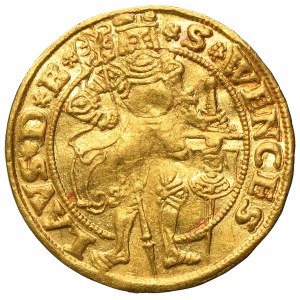
The obverse depicts Saint Wenceslas, Patron Saint of the Kingdom of Bohemia and one of the patron saints of Silesia, shown standing facing forward in full armour, holding a banner, sword, and shield. The depiction reflects Silesia's centuries-long affiliation with the Bohemian Crown and emphasizes the continuity of Bohemian state tradition following the accession of the Habsburg dynasty after the Battle of Mohács in 1526.
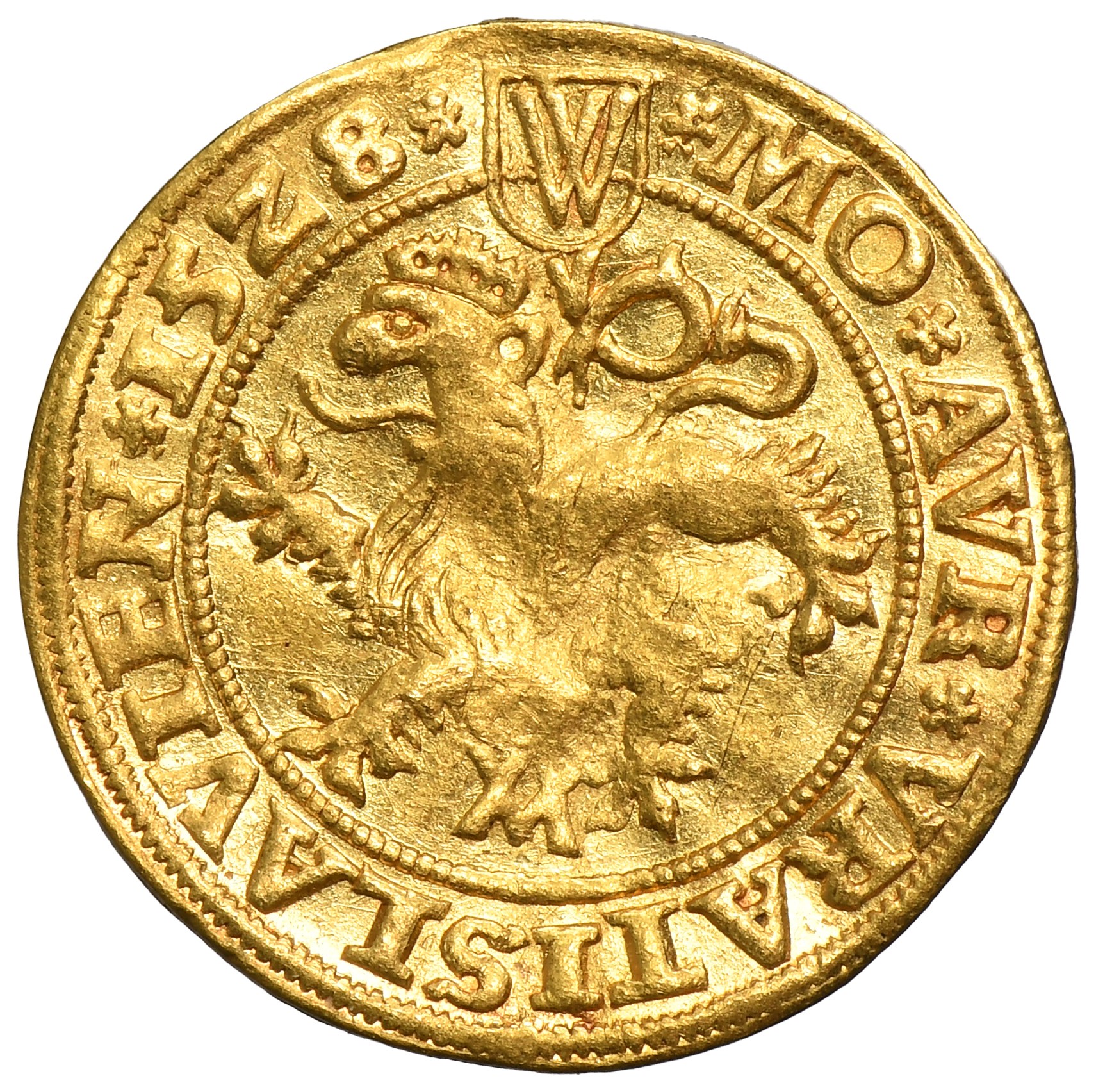
The reverse features the crowned Bohemian lion, the official coat of arms of the Kingdom of Bohemia. Above the lion appears a small shield bearing the letter "W", denoting the municipal mint of Wrocław. Below the lion is the numeral XX, referring to the contemporary mint standard under which twenty ducats were struck from one Cologne mark of gold.
An example with original mint luster in the fields.
Slightly wavy.
Owing to their very limited production, exceptional artistic quality, and considerable historical importance, the Wrocław ducats of 1528 are regarded among the most desirable gold coins of historic Silesia and occupy an important place in leading collections of Central European coinage.
Obverse: Saint Wenceslas standing facing, in full armour, holding a banner, sword, and shield.
S WENCES LAVS D B
Reverse: Crowned Bohemian lion; XX below, small shield with the letter W above.
MO AVR VRATISLAVIEN 15Z8
Gold, diameter 21 mm, weight 3.52 g